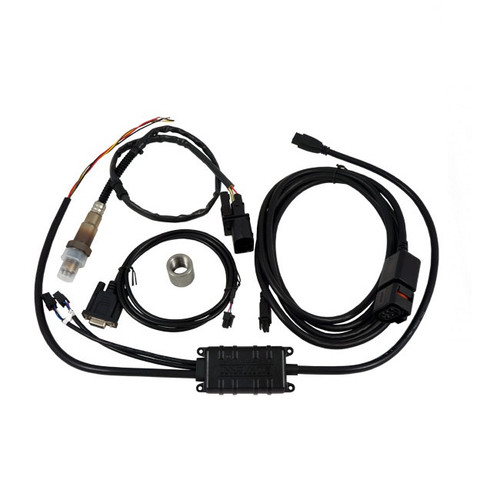


AMP EFI Wideband O2 Controller
Accurate wideband data is one of the most important inputs available to an engine management system. The AMP EFI Wideband Controller is designed to provide fast, stable Lambda/AFR feedback for standalone ECU tuning, closed-loop fuel control, and datalogging.
Built around a Bosch LSU 4.9 wideband oxygen sensor and genuine Bosch controller electronics, the AMP Wideband combines OEM-level sensor control with the flexibility required for modern performance applications.
Where this controller really stands out is its ability to communicate through either CANBus or a fully isolated 0–5V analog output. This makes it an excellent choice for MegaSquirt/MS3Pro installations as well as Haltech and other standalone ECU systems capable of accepting configurable CAN or analog wideband data.
CANBus Integration
For compatible engine management systems, the AMP Wideband can broadcast Lambda directly over CANBus.
This eliminates the need to consume an analog ECU input and avoids many of the voltage offset and grounding issues that can affect traditional analog wideband installations. Configurable CAN IDs also allow multiple wideband controllers to operate on the same CAN network.
CAN output range:
0.50–1.50 Lambda
Isolated 0–5V Analog Output
For ECUs that don't support the AMP CAN protocol—or applications where an analog connection is preferred—the controller provides an electronically isolated 0–5V output with a dedicated sensor ground.
The isolated circuit helps prevent ground offsets between the wideband controller and ECU, improving the accuracy of the AFR value actually received by the engine management system.
Analog scaling:
- 0.00V = 0.50 Lambda / 7.35 AFR gasoline
- 5.00V = 1.50 Lambda / 22.05 AFR gasoline
Bosch LSU 4.9 Technology
The system utilizes the proven Bosch LSU 4.9 wideband oxygen sensor along with genuine Bosch control electronics.
Proper Bosch heater control provides rapid sensor warm-up while helping maintain sensor reliability and lifespan. The controller also supports diagnostic fault detection for easier troubleshooting.
Built for Performance Applications
Unlike controllers intended strictly for interior gauge installations, the AMP Wideband is housed in a sealed, weather-resistant metal enclosure suitable for installation inside the cabin or engine compartment.
Operating temperature is rated from -40°F to 257°F (-40°C to 125°C).
Features
- Genuine Bosch wideband controller electronics
- Bosch LSU 4.9 wideband O2 sensor compatibility
- Fast and stable Lambda/AFR measurement
- CANBus output
- Configurable CAN IDs
- Supports multiple widebands on a CAN network
- 0.50–1.50 Lambda CAN broadcast
- Fully isolated 0–5V analog output
- Dedicated analog sensor ground
- Helps eliminate ECU/wideband ground-offset errors
- Weather-resistant sealed metal enclosure
- 12V automotive operation
- -40°C to 125°C operating temperature
- Designed and manufactured in the USA
ECU Compatibility
CANBus or Analog
- AMP EFI / MS3Pro
- MSPNP-Pro
- MS3X
- MS3
- Other compatible standalone ECUs and dataloggers
Analog
- MSPNP2
- MS2
- Haltech
- MaxxECU
- Other standalone or factory ECU systems capable of accepting a configurable 0–5V wideband input
Available Configurations
Controller Only
- AMP EFI Wideband Controller
Controller + Harness
- AMP EFI Wideband Controller
- Sensor cable
- Power/communication harness
Complete Controller + Sensor Package
- AMP EFI Wideband Controller
- Sensor cable
- Power/communication harness
- Genuine Bosch LSU 4.9 wideband O2 sensor
Fab9 Notes
For standalone ECU installations, we strongly recommend utilizing CAN communication whenever the ECU and installation support it. CAN eliminates analog voltage-offset errors and leaves valuable analog inputs available for other sensors.
For analog installations, the AMP controller's isolated output and dedicated sensor ground make it particularly well suited to accurate ECU datalogging and closed-loop fuel control.